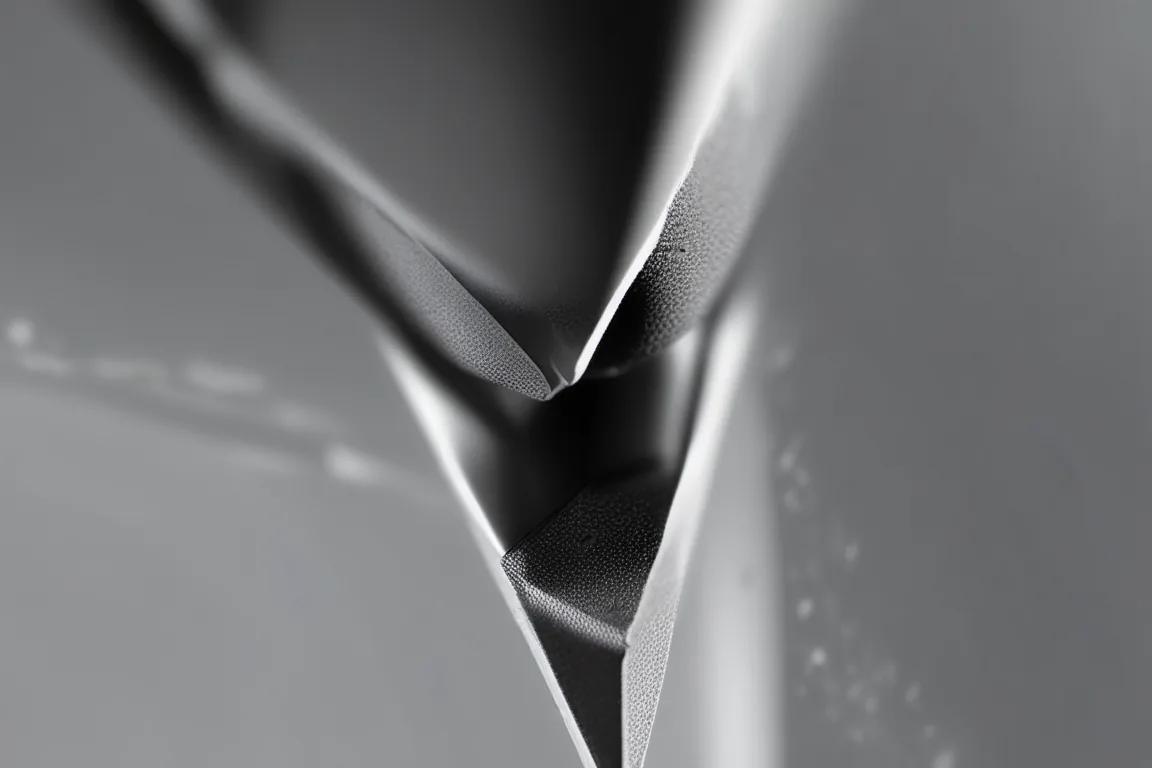
Thinner web reduces chisel edge thrust, letting smaller drills cut harder materials effectively at high speeds and feeds. Web thinning enhances strength-to-weight ratio without compromising durability up to 93 HRC hardness. This design improvement enables precise control over chip formation, reducing cutting forces by distributing loads evenly across the drill's geometry. Lower thrust means less deflection in small diameters, improving hole quality and surface finish at optimal speeds of 70 to 130 m/min.
What this geometry controls
A thinner web reduces chisel edge thrust, allowing smaller drills to cut hard materials effectively at high speeds and feeds. Web thinning enhances strength-to-weight ratio, enabling better stability during drilling operations. The 135-degree point angle creates a sharp cutting edge that minimizes cutting forces on the material surface. This geometry distributes cutting forces more evenly across the drill's length, reducing stress concentrations. By minimizing chip thickness variation, consistent chip evacuation improves overall tool performance and lifespan.
A thinner web reduces chisel edge thrust, allowing smaller drills to cut hard materials effectively at high speeds and feeds. The 89–93 HRC hardness of carbide ensures durability against wear and tear in tough drilling conditions. Distributing cutting forces evenly minimizes vibrations, which leads to smoother hole quality and reduced surface finish issues. Reduced thrust means less friction between the drill and material, lowering heat generation during operation. This design allows for optimal chip control and evacuation at various feed rates and spindle speeds.
| Specification | Value |
|---|---|
| Point angle | 135 ° |
| Carbide hardness | 89–93 HRC |
| Series diameter range | 0.04–3 mm |
The trade-off it brings
Thinning the web reduces chisel edge thrust, letting smaller drills cut hard materials effectively at high speeds and feeds. Thinner webs enhance strength-to-weight ratio but sacrifice durability against impacts. Durability drops because thinner webs deform more easily under shock loads compared to thicker designs. Impact resistance is crucial when drilling into brittle or unexpected material inclusions.
A compromised web may lead to premature failure, especially at lower rotational speeds where sudden forces are more damaging. Thicker webs handle shocks better due to their structural integrity, making them suitable for less predictable materials or conditions. However, they generate higher thrust forces during cutting operations, limiting their use in harder and more abrasive applications. Balancing durability with effective cutting requires careful selection based on the specific drilling scenario.
Where it is the right choice
For drilling through hard alloys like titanium or inconel, choose DC426 due to its thin web design. This reduces chisel edge thrust, allowing high-speed operations at 70–130 m/min feed rate.
DC426 performs well in deep hole drilling with a 135° point angle, ensuring stability and accuracy even at lower speeds of 9000 rpm. Its carbide hardness range of 89–93 HRC provides excellent wear resistance under heavy loads.
Where it is misapplied
Choosing a drill with a thick web for hard materials at high speeds is incorrect because it increases chisel edge thrust significantly. This excessive force can lead to premature wear and breakage of the tool. Drills like DC426 are specifically designed for thin webs, reducing the thrust and allowing them to cut efficiently in titanium or inconel. For softer materials, a thicker web drill may be more suitable as it provides better structural integrity without high chisel edge thrust. Using a thick-web drill on hard materials at lower speeds can also be inefficient because it limits the feed rate and rotational speed potential of the tool.
This limitation reduces productivity and increases cycle time unnecessarily. For softer alloys, such drills offer stability due to their robust construction but may not exploit the full cutting capacity of modern carbide technology. Optimal performance requires selecting a drill that matches material hardness with its design characteristics. Misapplication of thick-web drills can lead to wasted potential in terms of speed and feed rates, ultimately resulting in higher costs per hole drilled compared to properly matched thin-web alternatives. Always consult specific application guidelines before choosing between these designs.
Frequently asked
What is web thickness for carbide drills?
Web thickness affects the strength and thrust of carbide drills. A thinner web reduces the chisel edge's pushing force, allowing small drills to cut hard materials effectively.
How does point angle impact drilling performance?
A 135-degree point angle optimizes cutting efficiency by balancing chip evacuation and thrust forces, making it ideal for various drilling applications in metalworking.
What are optimal speeds for DC426 drills?
Optimal speeds for DC426 carbide drills range from 9000 to 20000 rpm depending on material hardness. Lower speeds suit harder materials while higher speeds work well for softer metals, ensuring efficient drilling operations.