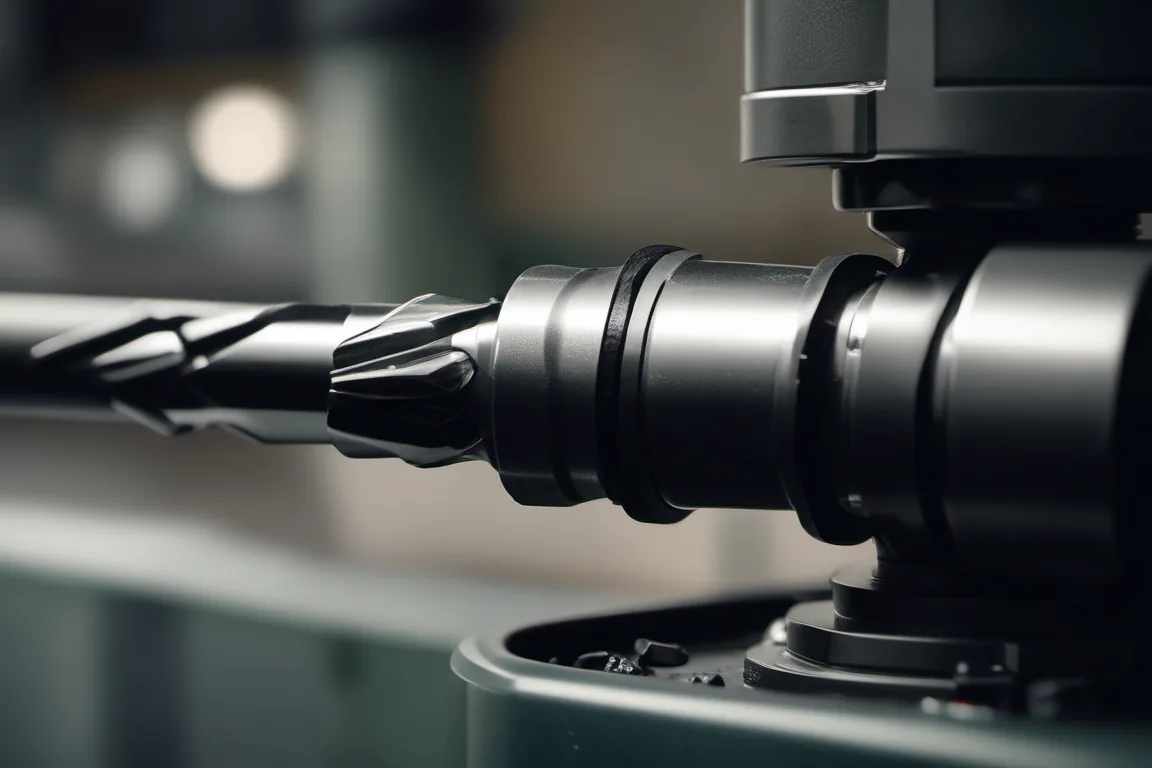
Reducing feed at breakthrough prevents exit burrs and delamination for high-hardness materials like carbon. Decreasing feed from 75 mm/min to 50 mm/min when exiting supports cutting integrity, reducing chip formation issues. This adjustment ensures smoother transitions through thin or unsupported sections. It also minimizes tool deflection risks by maintaining consistent cutting forces throughout the process. Thus, it enhances overall part quality and prolongs tool life during critical operations.
The variable and the range it can take
The variable affecting breakthrough performance is the feed rate during machining. For high-hardness materials like carbon steel, the recommended feed rate ranges from 50 mm/min to 75 mm/min.
Adjusting this range ensures optimal cutting conditions and reduces exit burrs at breakthrough points. Lowering the feed helps prevent delamination commonly seen with sudden material changes. Feed rates should be decreased gradually as the tool approaches the end of the cut area.
| Specification | Value |
|---|---|
| Point angle | 130 ° |
| Carbide hardness | 1800–2000 HV |
| Series diameter range | 0.07–4.98 mm |
What it changes in the cut
Reducing feed rate at breakthrough reduces cutting force on the tool edge significantly. Lower forces prevent sudden deflection and improve surface finish quality near the exit point. Decreased feed also lowers temperature at the cutting interface for high-hardness materials like carbon steel. Cooler temperatures extend tool life by reducing thermal stress and wear on carbide edges. Reduced feed creates finer chips, which helps remove heat more efficiently from the cutting zone.
Finer chips result in smoother surfaces and less residual stress on the machined part. Lowering feed at breakthrough prevents chipping and cracking of fragile materials during exit. Smaller chip loads reduce the likelihood of delamination along grain boundaries at the end of cuts. A finer, controlled feed rate ensures a consistent tool path through material transitions. Consistent cutting conditions yield more predictable results and higher dimensional accuracy in parts.
Where the limit comes from
Carbide hardness ranges from 1800 HV to 2000 HV, providing durability and wear resistance at high speeds. The geometry of DC336 with a 130° point angle supports precise cutting during breakthrough operations. Feed rates should decrease as the material’s supporting structure weakens and disappears towards the end. Lowering feed from 75 mm/min to 50 mm/min reduces sudden force spikes that can damage the tool edge. This adjustment helps maintain surface finish quality without risking exit burrs or delamination issues.
Breakthrough occurs when the material's remaining support is insufficient for maintaining stable cutting conditions. At this point, reducing feed below 750 mm/min prevents excessive forces on the cutting edge and chatter. Common micro-finishing operations use lower fz values of 0.02 to 0.08 mm/tooth for finer surface finishes. Reduced ap from 0.1 to 0.5 mm also contributes to minimizing tool deflection during critical final stages. These adjustments ensure consistent performance and quality in the last fractions of material removal.
Setting it in practice
To set up DC336 for a job, start by selecting the appropriate spindle speed based on material hardness. For carbon steel at high hardness levels, use 25000 rpm initially; lower speeds like 18000 or 15000 rpm are suitable for softer materials.
Adjust feed rates according to the material type and cutting conditions. Use 75 mm/min for general applications and reduce this to 50 mm/min when approaching breakthrough. Lowering feed ensures a smoother entry into the final cut without tool deflection.
Frequently asked
How do I prevent exit burrs when cutting?
Reduce feed rate slightly as your carbide tool breaks through material. This prevents delamination and reduces burring at the exit point.
What is the ideal rpm for DC336 tools?
For optimal performance, use DC336 tools with rpm settings of 25000, 18000, or 15000 depending on your material thickness and hardness requirements.
How do I adjust feed rate during cutting?
Adjust the feed rate according to material type. Use lower values like 50 mm/min for thin materials and higher settings up to 750 mm/min for thicker sections.