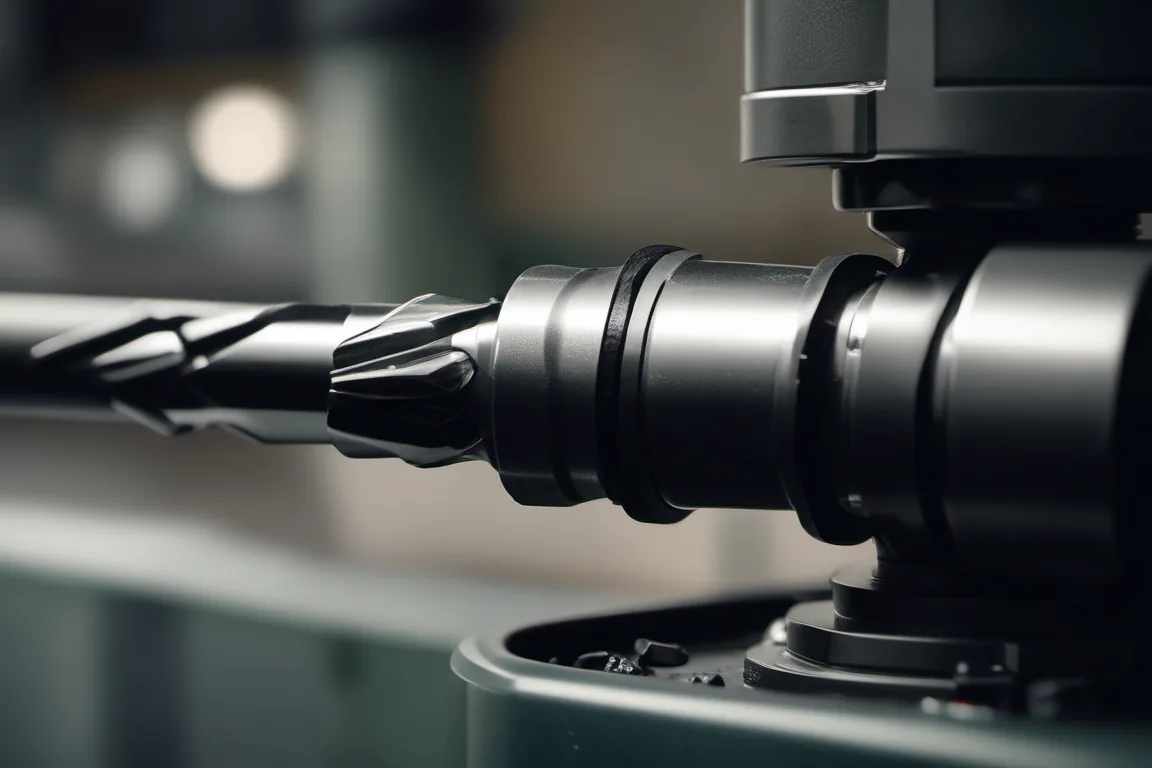
Runout affects micro drills more than larger ones due to their smaller diameters and higher hardness, ranging from 89 to 93 HRC. Uneven wear on 1 edge accelerates tool failure, reducing tool life significantly. Precision collets help manage runout but cannot eliminate the impact entirely. The DC426 series, designed for small diameters up to 3 mm, minimizes this issue with optimized geometry and coatings. Maintaining strict control over runout improves overall productivity by extending tool life in micro drilling applications.
The variable and the range it can take
Runout is a measure of how much a tool's axis deviates from its ideal position during rotation. This deviation affects micro drills more than larger ones because their smaller diameters amplify any imbalance. Micro drill runout typically ranges between 0.005 and 0.02 millimetres, depending on the application’s precision requirements. Higher precision applications use lower values to ensure consistent cutting conditions. For general machining tasks, acceptable runout can be as high as 0.08 millimetres.
However, even a slight deviation impacts tool life and surface finish quality significantly. The runout tolerance must match the drill diameter proportionally. For instance, a 0.1-millimetre drill should have runout less than its diameter to maintain optimal performance. Runout beyond these limits causes uneven wear on the cutting edges, which leads to premature failure of the tool. Precise collets and fixturing are crucial for micro drills to minimize this issue.
| Specification | Value |
|---|---|
| Diameter | 0.1 mm |
| Carbide hardness | 89–93 HRC |
| Series diameter range | 0.04–3 mm |
What it changes in the cut
Runout causes uneven load distribution on the cutting edges, principal 1 edge to do twice the work of the other. This unequal wear accelerates tool degradation and reduces overall lifespan. For micro drills with diameters under 0.1 mm, runout effects are magnified due to their smaller size. Hardness in the range of 89–93 HRC makes them more susceptible to wear from uneven forces. As a result, using precision collets is crucial for maintaining tool performance and longevity.
Increased runout raises temperatures on one cutting edge over the other. This temperature imbalance can cause thermal stress, which leads to rapid wear or chipping. The recommended feed rate of 0.02–0.08 mm per tooth helps distribute heat more evenly across both edges. A lower axial depth of cut (AP) within 0.01–0.05 mm minimizes the impact of temperature fluctuations on tool life. Maintaining these parameters ensures consistent cutting performance and reduces the risk of catastrophic failure.
Where the limit comes from
Runout limits are set by the drill's geometry and cutting parameters. Smaller drills, like DC426 at 0.1 mm diameter, have less tolerance for runout. Carbide micro drills range from 89 to 93 HRC, making them brittle but hard. Higher hardness means more wear on 1 edge under uneven load. Runout causes one cutting edge of the drill to work harder than the other.
This leads to faster wear and reduced tool life at small diameters. The acceptable runout depends on chip thickness and axial depth. Micro drills use ap values from 0.01 to 0.05 mm, making them sensitive to deviations. Precision in mounting is crucial for micro drilling. A quality collet minimizes runout and ensures even wear across the drill's edges.
Setting it in practice
To set a micro drill in practice, first ensure the collet is tight and true to minimize runout below 0.01 mm for optimal cutting performance.
Adjust feed rate according to material hardness and surface finish; softer materials require lower feeds than harder ones like steel or cast iron.
Frequently asked
How much runout can a micro drill handle?
Micro drills absorb minimal runout, typically less than \( \pm 0.1 \) mm for optimal performance. Runout causes uneven wear and faster tool degradation on the side doing more work.
What is the right diameter range for DC426 drills?
DC426 drills cover a range from \( 0.04 \) to \( 3 \) mm, suitable for precise micro-drilling applications where tight tolerances are essential.
How do I set feed rates for micro drilling?
For micro drilling with tools like the DC426 series, use fine feeds between \( 0.005 \) and \( 0.02 \) mm/tooth to maintain tool life and surface finish quality.