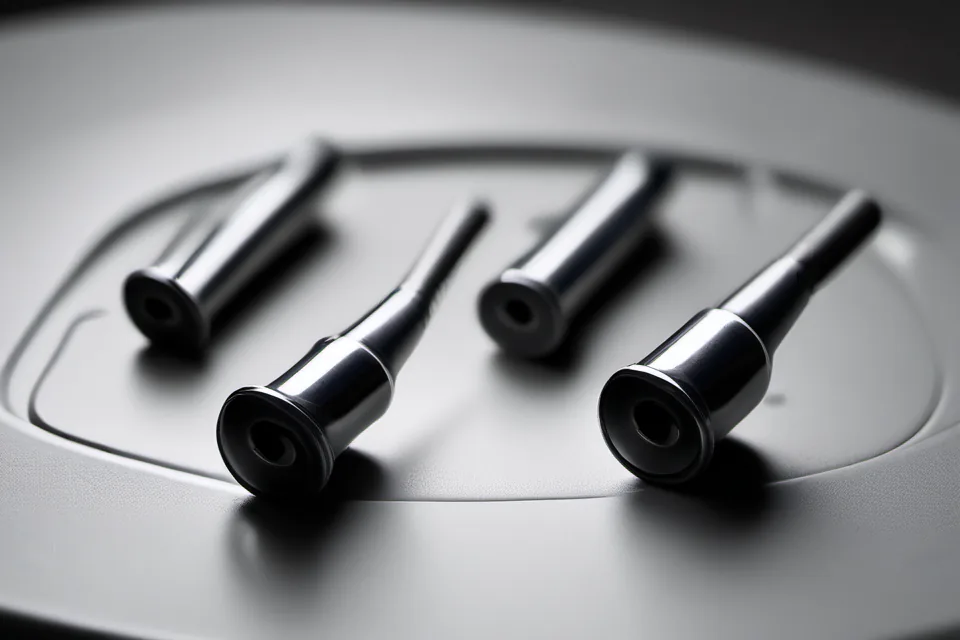
Carbide tools with bronze coating and 140-degree point angle excel in pre-hardened mould steels by resisting abrasive wear better than other materials. Their hardness range from 89 to 93 HRC allows them to maintain sharp edges during high-speed cutting at 60 to 110 m/min feed rate. At these speeds, the tools prevent rapid flank wear and size drift in moulds made of HRC 30 to 40 steel. This stability ensures consistent hole dimensions throughout machining operations without frequent tool changes. Thus, these carbide tools extend service life and improve productivity in pre-hardened steel applications.
The mechanism
Carbide’s hardness at 89–93 HRC allows it to resist abrasive particles in pre-hardened steel effectively, maintaining sharp edges longer than softer materials. Abrasive wear starts on the flank, where carbide slowly erodes under continuous cutting forces and contact with hard particles, widening the hole gradually over time. As wear progresses, a measurable increase in hole diameter indicates tool degradation, revealing loss of precision before catastrophic failure occurs.
The bronze coating on these tools further enhances durability by reducing friction and heat buildup during machining operations at various speeds and feeds. Operators can select appropriate spindle speeds such as 17000 rpm or lower, depending on material hardness and feed rates like 35 mm/min to minimize wear.
| Specification | Value |
|---|---|
| Point angle | 140 ° |
| Carbide hardness | 89–93 HRC |
| Series diameter range | 0.14–14.2 mm |
The conditions that produce it
Abrasive wear appears when cutting pre-hardened mould steel between HRC 30 and 40 at high speeds and feeds, typically around 60 to 110 m/min and up to 210 mm/min feed. At these conditions, the tool’s flank wears gradually, widening holes slowly over time as the bronze coating resists abrasive particles effectively compared to other materials. Abrasive wear remains minimal when cutting at lower speeds below 60 m/min or using finer feeds under 50 mm/min, reducing heat and friction on the tool edge significantly.
Using a geometry with a 140-degree point angle helps distribute forces more evenly across the tool face, preventing concentrated stress points that could accelerate flank wear. Maintaining optimal cutting parameters within specified ranges keeps abrasive wear at bay, extending tool life and maintaining hole dimensions accurately in pre-hardened mould steel.
How to recognise it on the tool
Abrasive wear on carbide tools appears as a gradual widening of the hole's edge, creating a slightly larger diameter than intended after machining.
The wear land becomes visibly wider over time, often starting near the cutting edges where abrasive particles concentrate.
What actually removes the cause
Carbide tools with a point angle of 140 degrees ensure efficient chip evacuation during high-speed cutting operations on pre-hardened steel.
The sharp edges of carbide maintain their form longer because of hardness levels between 89 to 93 HRC, resisting abrasive wear effectively.
Frequently asked
What's the right rpm for mould steel cutting?
For pre-hardened mould steels (HRC 30-40), use higher rpms like 17000, 10000, or 7000 to manage heat and reduce abrasive wear. Lower speeds can cause overheating and increased flank wear.
What feed rate should I use for mould steel?
Use a moderate feed rate of 35 mm/min or 50 mm/min to prevent excessive heat build-up during cutting. For rougher operations, consider 80 mm/min or 210 mm/min depending on the tool's capabilities and material hardness.
Which carbide tools work right for mould steel?
For pre-hardened mould steels (HRC 30-40), choose tools like DC836L with a 140° point angle. This geometry helps manage heat and wear, maintaining hole size accuracy over time.