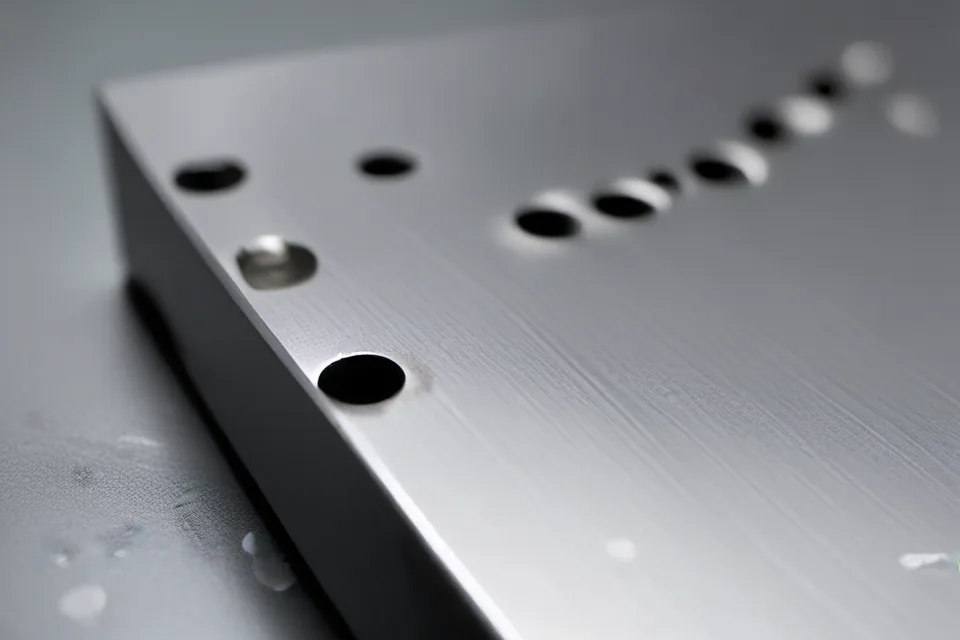
DC426 drills outperform others by staying rigid and sharp under austenitic stainless steel's wear-inducing conditions. Its high hardness range (89–93 HRC) prevents edge blunting, maintaining cutting action against work hardening. Geometry matches feed rates to avoid chip pileup: smaller drills use slower feeds than larger ones for clearance. Speeds vary widely too—higher rpm for 0.6 mm, lower for 0.8 mm—to manage heat and maintain the cut's integrity. With proper settings, DC426 ensures consistent hole quality without part displacement or edge degradation during drilling operations.
The physics at this diameter
At 0.8 mm, the drill's cutting edge forms chips by shearing stainless steel. This sheared material work-hardens immediately under the tool’s edge. Work-hardening raises local temperature, which the hard carbide (HRC 89–93) resists effectively. Higher hardness means better wear resistance against stainless steel’s abrasive nature. Drill rigidity decreases slightly at larger diameters but maintains stability crucial for thin workpieces.
Smaller drills up to 0.6 mm have less clearance space, affecting chip evacuation efficiency. Clearance volume increases with diameter at 0.8 mm, improving coolant flow and chip removal. This reduces heat accumulation around the cutting edge, enhancing tool life further. Coolant application becomes increasingly important as diameter grows past 0.6 mm, aiding in temperature control during drilling operations. Proper cooling is essential for maintaining optimal cutting conditions.
| Specification | Value |
|---|---|
| Diameter | 0.6 mm |
| Diameter | 0.8 mm |
| Carbide hardness | 89–93 HRC |
| Series diameter range | 0.04–3 mm |
What this material demands
The drill's edge faces immediate work-hardening from stainless steel. This hardening increases friction at the cutting interface, raising temperatures significantly. High temperatures can reduce carbide hardness (89–93 HRC), accelerating wear and dulling edges faster. To maintain performance, DC426 must have a consistent geometry that ensures chip formation and removal under these conditions. A smaller diameter of 0.6 mm behaves similarly but experiences less heat buildup due to reduced material volume. Work-hardening requires the drill to cut continuously without sliding on the surface.
Sliding increases wear and can cause edge damage. DC426’s sharpness helps prevent this by maintaining a cutting angle that resists rubbing against stainless steel. The tool's rigidity is crucial for resisting deflection in unsupported thin parts, further preventing unwanted contact. At higher speeds (15000 rpm), the drill must manage heat effectively to avoid compromising its hardness and performance. Lower feed rates (30 mm/min) help control chip thickness and improve cooling at the cutting edge.
Tooling that fits the combination
DC426 uses a geometry optimized for stainless steel, balancing chip formation and evacuation at high speeds. Its sharp edge ensures efficient cutting without excessive friction. Material hardness ranges from 89 to 93 HRC, ensuring durability against work-hardening effects. A sharper edge reduces heat buildup by minimizing sliding contact areas. The drill’s diameter of 0.8 mm matches the material's optimal geometry for this size.
This alignment maximizes tool life and hole quality during drilling operations. Using a softer carbide or less suitable coating would lead to rapid wear from work-hardened stainless steel. High hardness retains edge sharpness, crucial for maintaining performance. An alternative with lower HRC might save costs but fails under the heat-induced hardening of austenitic stainless steel. DC426’s superior materials ensure consistent cutting across various conditions.
Cutting data and where it stops working
When drilling at 0.8 mm, increasing feed rate first degrades hole quality if cutting data changes. Higher feed rates create more friction, raising temperatures. Temperatures rise faster than tool material can dissipate heat, causing wear and deformation. At 150 mm/min, the DC426 starts to lose sharpness quickly. Reduced rpm next affects performance as chip control becomes harder at lower speeds. Slower rotation means less cooling from chips ejected.
Heat builds up near the cutting edge. Heat buildup weakens carbide hardness from 89–93 HRC, reducing wear resistance. Once this happens, tool life drops sharply and hole finish worsens noticeably. Process limits sit where feed rate reaches 150 mm/min or rpm falls below 5000. Beyond these values, the drill fails to maintain dimensional accuracy in stainless steel.
Frequently asked
What is the recommended rpm for drilling 0.8 mm holes in stainless steel?
For drilling 0.8 mm diameter holes in austenitic stainless steel, use an rpm range of 5000 to 7000 based on material hardness and workpiece stability.
How do I prevent tool wear when drilling small holes in stainless steel?
Use a drill with a black coating like DC426 for better heat resistance. Maintain optimal cutting parameters: vc between 60-120 m/min, feed at 30 mm/min, and keep the part supported to avoid work hardening.
What diameter should I use if my hole is 0.8 mm?
For a 0.8 mm hole in stainless steel, select a drill with an exact or slightly smaller diameter than your target size, such as DC426 series, to ensure proper chip formation and clearance.